


Periodontics Residency
book_2 Learning Mode: Residential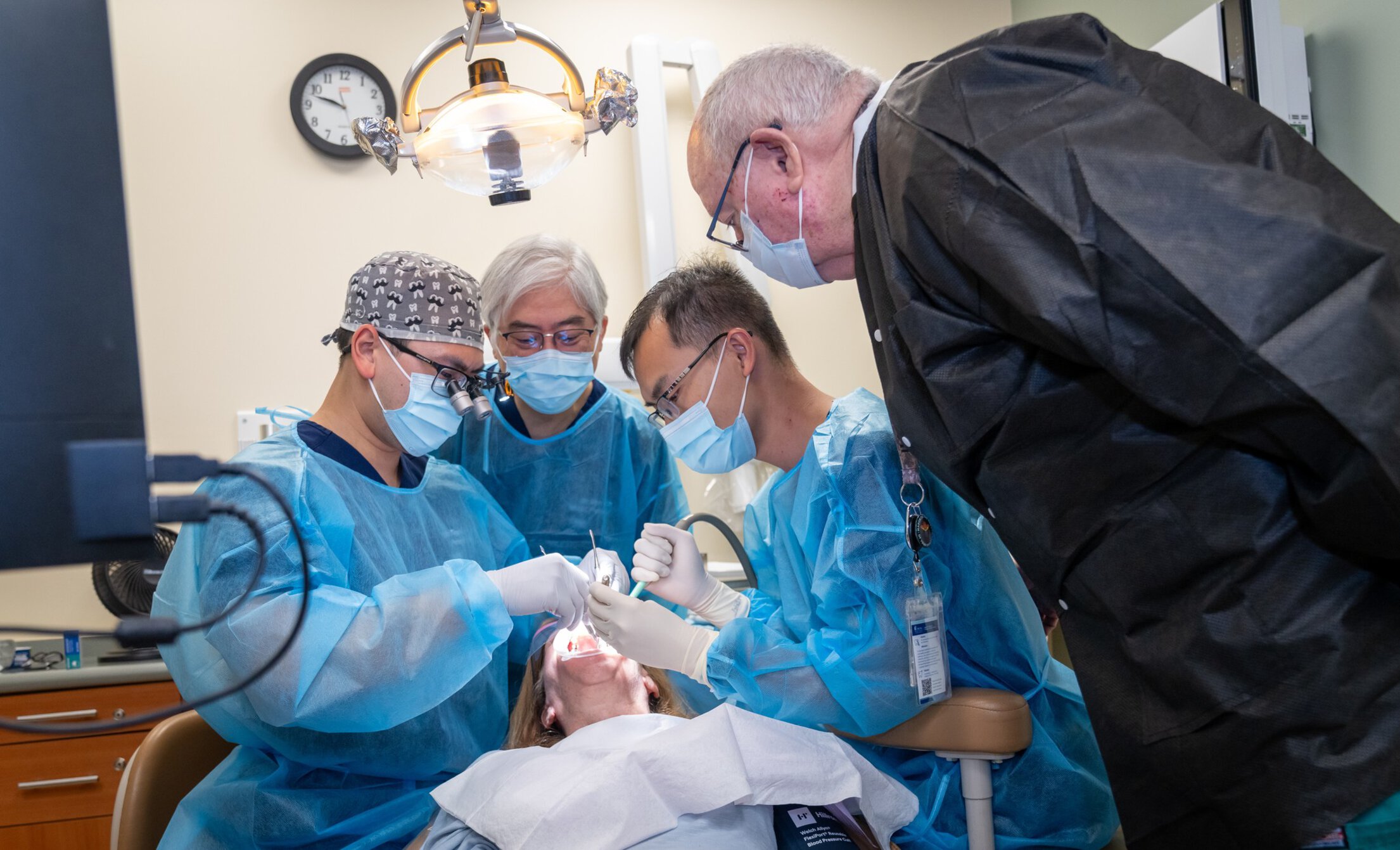
Program Overview
The Periodontics Residency program is designed for dentists who want to become clinically skilled periodontal specialists. At MUSC, you'll train in a CODA-accredited, residential program that connects advanced patient care, seminars and thesis-based research. You’ll build expertise in periodontal examination, nonsurgical and surgical therapy, esthetic periodontal surgery, guided tissue regeneration, osseous grafting, implant placement, site preparation, hospital anesthesia, IV moderate sedation and supportive periodontal therapy. You'll complete a master's degree with the clinical certificate, engage in treatment planning and literature review seminars and prepare for board certification, teaching, research and advanced specialty practice.
Application Timeline
May 13, 2026 - Feb 12, 2027
Training Experience
Inside the Program
In this residential, CODA-accredited residency, you'll train as a developing periodontal specialist while completing a master's degree and clinical certificate. You’ll work across patient care, treatment planning, literature review, formal coursework and thesis-based research, giving you a strong foundation for clinical decision-making, teaching and scholarly inquiry.
You'll gain experience in:
- Periodontal examination and diagnosis
- Nonsurgical periodontal therapy
- Surgical periodontal therapy, including esthetic periodontal surgery
- Guided tissue regeneration and osseous grafting
- Implant placement and site preparation, including extraction, socket preservation, sinus augmentation and block grafting
- Hospital anesthesia, IV moderate sedation and supportive periodontal therapy
Who should apply
This program is for dentists who want intensive, full-time specialty training in periodontology and are ready to connect advanced clinical practice with academic and research expectations. You should be prepared for a minimum 35-month residential commitment, weekly treatment planning and literature review seminars, a research project, thesis and defense, and preparation for the American Board of Periodontology certification process.
Curriculum
Year 1, Summer
| Course ID | Course Title | Credits |
|---|---|---|
| GDENT701 | Preclinical Instruction | 1 |
| GDENT710 | Head and Neck Anatomy Review | 0.5 |
| GDENT834 | Advanced Topics in Radiology | 1 |
| GPERI864 | Advanced Periodontology | 2 |
| Semester Total | 4.5 | |
Year 1, Fall
| Course ID | Course Title | Credits |
|---|---|---|
| GDENT800 | Research Methodologies | 1.5 |
| GDENT801 | Teaching Methods | 1.5 |
| GDENT878 | Oral Medicine | 1.5 |
| GDENT899 | Research Thesis | 1 |
| GPERI871 | Advanced Periodontology II | 1 |
| GPERI870 | ADVP Treatment Planning Seminar | 1 |
| GDENT827 | Interdiscipl Dent Impl 1 | 1 |
| Semester Total | 8.5 | |
Year 1, Spring
| Course ID | Course Title | Credits |
|---|---|---|
| GPERI880 | Treatment Planning Seminar II | 1 |
| GDENT829 | Innov & Resch in Oral Health | 1 |
| GDENT863 | Dental Ethics & Behavioral Management | 1 |
| GDENT868 | Advanced Oral and Maxillo Path | 2 |
| GDENT899 | Research Thesis | 1 |
| GPERI872 | Advanced Periodontology III | 1 |
| GDENT828 | Interdispl Dent Impl II | 1 |
| Semester Total | 8 | |
Year 2, Summer
| Course ID | Course Title | Credits |
|---|---|---|
| GDENT899 | Research Thesis | 1 |
| GPERI873 | Advanced Periodontology IV | 1 |
| Semester Total | 2 | |
Year 2, Fall
| Course ID | Course Title | Credits |
|---|---|---|
| GDENT899 | Research Thesis | 1 |
| GPERI881 | Treatment Planning Seminar III | 1 |
| GPERI874 | Advanced Periodontology V | 1 |
| Semester Total | 3 | |
Year 2, Spring
| Course ID | Course Title | Credits |
|---|---|---|
| GDENT899 | Research Thesis | 1 |
| GPERI875 | Advanced Periodontology VI | 1 |
| GPERI882 | Treatment Planning Seminar IV | 1 |
| Semester Total | 3 | |
Year 3, Summer
| Course ID | Course Title | Credits |
|---|---|---|
| GPERI876 | Advanced Periodontology VII | 1 |
| GDENT899 | Research Thesis | 1 |
| Semester Total | 2 | |
Year 3, Fall
| Course ID | Course Title | Credits |
|---|---|---|
| GDENT899 | Research Thesis | 1 |
| GPERI883 | Treatment Planning Seminar V | 1 |
| GPERI877 | Advanced Periodontology VIII | 1 |
| Semester Total | 3 | |
Year 3, Spring
| Course ID | Course Title | Credits |
|---|---|---|
| GDENT899 | Research Thesis | 1 |
| GPERI884 | Treatment Planning Seminar VI | 1 |
| GPERI878 | Advanced Periodontology IX | 1 |
| Semester Total | 3 | |
| Curriculum Total | 37 | |
Periodontics Externship
The Periodontics Externship program is available to third- or fourth-year dental students enrolled in U.S. or Canadian dental schools who plan to apply to graduate periodontics programs, dentists enrolled in a general practice residency (GPR) or advanced education in general dentistry (AEGD) residency program or practicing dentists who wish to return to residency.
Externs will be invited to attend classes, observe the postdoctoral students in the clinic, and socialize with current residents. There is a maximum of three days per extern visit.
Applications should be submitted at least one month prior to the desired dates requested. Externs are responsible for their own lodging, transportation, and food.
Residency Application
Timeline
Due date: September 1
Start term: July 1
For example, to apply for the program that begins on July 1, 2024, the application is due September 1, 2023.
Application Requirements
Application as early as possible is strongly recommended. The deadline for all application materials includes those submitted to ADEA PASS.
- Our program participates in Phase I of the Match program. The Match and ADEA PASS share a registration portal for applicants, so applicants who want to register for the Match must go to the ADEA PASS website to complete the Match registration process. Applicants will be charged the Match registration fee at that time. For more information, visit National Matching Services.
- Apply through ADEA PASS. Application materials are accepted in mid-May. Note: the first step in using PASS is for the applicant to register and pay your PASS registration fee. Nothing will happen at PASS until you have paid and are registered.
- Official transcripts uploaded to ADEA PASS (all colleges, dental school). If you have attended a non-U.S. college/university, it is required that all international transcripts be evaluated by either ECE or WES foreign credentialing services. Applicants must be U.S. citizens or permanent residents.
- Three professional evaluation forms (letters of recommendation) uploaded to ADEA PASS.
- Institution evaluation form (formerly called the dean’s letter) submitted by the Dean’s Office to ADEA PASS. This form will include GPA, Class Rank and National Board Examination scores.
- GRE and/or ADAT scores uploaded to ADEA PASS. All applicants who graduated from a dental school not accredited by the Commission on Dental Accreditation are required to take either the GRE or the Advanced Dental Admission Test (ADAT); applicants may take both exams if they desire but must take at least one. GRE scores taken more than 5 years before the application date will not be accepted.
- Official Test of English as a Foreign Language (TOEFL) score if requested.
Application Fee
Applicants must send an application fee of $75. The check may be made payable to the Medical University of South Carolina and can be sent to:
Mary Catherine James
College of Dental Medicine
Department of Advanced Specialty Sciences
Division of Periodontics
173 Ashley Avenue, BSB 119, MSC 507
Charleston, SC 29425-5070
Funding your path forward
Tuition & Fees
Tuition and fees listed below apply to the 2026-27 academic year and are per semester unless otherwise noted.
| Fee Type | Fee |
|---|---|
| Application Fee (per application) | $95 |
| Matriculation Fee (upon applicant acceptance) | $485 |
Full-Time
| Tuition/Fee Type | Fall | Spring | Summer |
|---|---|---|---|
| In-State Tuition | $3,218 | $3,218 | $2,963 |
| Out-of-State Tuition | $5,418 | $5,418 | $4,994 |
| Program Fee | $2,300 | $2,300 | - |
| International Student Fee | $15,000 | $15,000 | - |
Cost of Attendance
The Cost of Attendance, or COA, estimates the total educational expenses for an enrollment period. The information below reflects the 2026-27 academic year. The COA includes direct costs, such as tuition and fees, billed by the university, as well as indirect costs you may need to plan for, including housing, food, transportation, books and other personal expenses.
The COA helps determine the maximum amount a student may borrow in an academic year and supports funding-related determinations, such as grants, scholarships, loans and others.
Your actual expenses may be lower than the COA, especially with careful budgeting. MUSC's Office of Student Financial Literacy can help you create a budget that supports your education, personal needs and long-term financial goals.
| Item | Year 1 | Year 2 | Year 3 | Est. Total |
|---|---|---|---|---|
| Direct Costs | ||||
| In-State Tuition | $9,399 | $9,399 | $9,399 | $28,197 |
| Out-of-State Tuition | $15,178 | $15,178 | $15,178 | $45,534 |
| Health Insurance | $5,045 | $4,000 | $4,000 | $13,045 |
| Fees | $4,975 | $4,900 | $4,900 | $14,775 |
| In-State Total Direct Costs | $19,419 | $18,299 | $18,299 | $56,017 |
| Out-of-State Total Direct Costs | $25,198 | $24,078 | $24,078 | $73,354 |
| Indirect Costs | ||||
| Living Expenses (Food and Housing) | $24,882 | $27,144 | $27,144 | $79,170 |
| Miscellaneous Personal Expenses | $2,640 | $2,880 | $2,880 | $8,400 |
| Transportation | $2,970 | $3,240 | $3,240 | $9,450 |
| Books, Course Materials, Supplies and Equipment | $12,510 | $5,060 | $5,860 | $23,430 |
| Total Indirect Costs | $43,002 | $38,324 | $39,124 | $120,450 |
| Estimated Total Costs | ||||
| In-State Total Costs | $62,421 | $56,623 | $57,423 | $176,467 |
| Out-of-State Total Costs | $68,200 | $62,402 | $63,202 | $193,804 |
Scholarships & Aid
MUSC offers scholarships for which you may be eligible. Some are awarded based on academic achievement; others are awarded based on community service, for example. However, the majority of scholarships awarded at MUSC are based on financial need. This means that these scholarships are only awarded to students who need some financial assistance to cover the cost of tuition and fees. If you would like to be considered for a financial need-based scholarship, you must have an up-to-date Free Application for Federal Student Aid (FAFSA) on file. Make sure you list the Medical University of South Carolina on your FAFSA form, along with MUSC's code: 003438. We encourage you to submit your FAFSA as early as possible. It is recommended to submit your FAFSA in January if you plan to enroll in the fall.
Annual Stipend
Stipends are contingent on the availability of funds. Regardless of the availability of stipend support, teaching responsibilities are required as a part of the program.
Frequently Asked Questions
You’ll build a strong academic, clinical and research foundation for advanced periodontal practice. Your training will include periodontal examination, treatment planning, nonsurgical therapy, surgical therapy, implant placement, site preparation, hospital anesthesia, IV moderate sedation and supportive periodontal therapy. The program also prepares you for the certification process of the American Board of Periodontology.
The combined master’s degree and clinical certificate program requires a minimum of 35 months. Depending on your research project and thesis defense timeline, you may need additional time to complete all requirements. The program is full time and does not offer a part-time option.